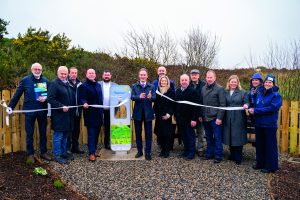
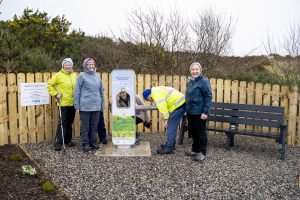
Alan Dillon TD, Minister of State at the Department of Climate, Energy and Environment with special responsibility for the Circular Economy, cuts the ribbon to officially launch the NFGWS Water Refill Station project with PBKS GWS members, staff and NFGWS representatives.
Access to safe, reliable drinking water is at the heart of every group water scheme and the National Federation of Group Water Schemes Drinking Water Refill Station Project is giving schemes a powerful new way to demonstrate that value directly within their communities. More than just a convenience for walkers or visitors, these stations are becoming highly visible symbols of the quality, professionalism and community spirit that define the GWS sector.
That opportunity was centre stage earlier this year as the NFGWS marked the launch of its Drinking Water Refill Station Project at Crucspullagadaun Loop Walk in Co. Mayo, hosted by PBKS Group Water Scheme. The event demonstrated how schemes can take a simple idea and turn it into a visible, lasting asset for their area.
The launch was addressed by Minister Alan Dillon, Minister of State at the Department of Climate, Energy and Environment with special responsibility for the Circular Economy, who officially unveiled the PBKS GWS refill station. At the event, the Minister remarked:
I am delighted to be here in Mayo today with local school children and the PBKS Group Water Scheme to launch this refill station which my department provided grant funding for. This exhibits the power of community in action, it’s clear how much can be achieved when people come together. This project reduces single‑use plastics, protects our environment, and gives people easier access to clean drinking water, a simple idea delivering big benefits for the whole community.
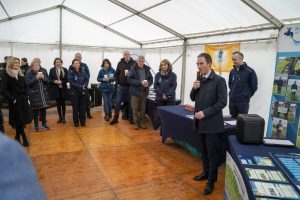
Alan Dillon TD, Minister of State at the Department of Climate, Energy and Environment addressing a large crowd including representatives from Mayo GWSs at the launch.
Practical Initiative
The refill station initiative, supported under the Department of Climate, Energy and the Environment’s Circular Economy Fund, is already delivering results on the ground. At time of going to press, 43 stations have been installed under the current programme, building on earlier pilots to bring the total to 80 refill stations across GWS locations nationwide.
For schemes, the benefits are clear. These stations provide a tangible public service, highlighting the quality and reliability of GWS-managed drinking water while enhancing local walking routes, recreational areas and village spaces. They also support national policy on improving access to drinking water and contribute to reducing single-use plastics. Just as importantly, they create a natural focal point for engagement within the community, offering schemes a simple way to showcase their work and build awareness of the value of community-managed water services.
Local school children played a big role on the day bringing energy and fun to the event at the Crucspullagadaun Loop Walk in county Mayo.
Community Connections
One of the most significant advantages of the refill station programme is its ability to strengthen community engagement. Positioned in high-footfall areas, the stations bring the work of group water schemes into everyday public view, reinforcing trust and pride in the local supply.
Schemes involved in the project have also linked the stations with school engagement activities, including the All About Water programme. By providing reusable bottles and supporting classroom learning, schemes are not only promoting sustainable habits but also building awareness among younger generations of how their water is sourced, treated and protected. This increased visibility creates valuable opportunities to connect with the wider community, including potential new volunteers. By making their work more visible and better understood, schemes can encourage greater local involvement and support.
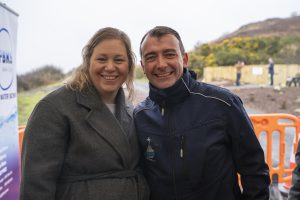
Esther Walsh PBKS GWS and Barry Dolan NFGWS in front of the water refill station.
PBKS GWS Leading by Example
The launch in Mayo highlighted the leadership role that individual schemes can play. PBKS Group Water Scheme was recognised for its strong track record in sustainability, source protection and biodiversity, as well as its commitment to community engagement. The efforts the GWS went to in preparing for the event and giving everyone a warm welcome on a wet day was remarkable.
Set against the backdrop of Croagh Patrick, Lough Conn and Lough Carra, the location served as a reminder of what is being protected, and of the important role schemes continue to play in safeguarding these resources. Speaking at the event, NFGWS CEO Mark Farrelly emphasised the wider significance of the initiative:
This project has shown just how powerful our group water schemes can be when they work together with a shared purpose. Each new refill station represents more than improved access to drinking water, it reflects a community taking pride in its place, protecting its environment, and choosing sustainable habits that benefit everyone. What always impresses me is the ambition and energy, exemplified by PBKS GWS. Local volunteers and staff consistently step up and deliver projects that make a real difference on the ground.
The refill stations’ branding promotes community involvement in climate action and drinking water source protection, delivering the message that ‘Safe drinking water starts with us all’. We’re proud to support our members as they invest in their communities, strengthen local amenities, and champion a cleaner, greener future for rural Ireland.
Many local walkers joined the event and tested out the new refill station for the cameras.
GWS Opportunity
The success of the refill station programme provides a clear model that other group water schemes can follow. With support from the NFGWS, schemes have the opportunity to develop practical projects that benefit their communities, improve local amenities, raise their profile and strengthen community ties, while also creating pathways to attract new committee members and volunteers.
For many schemes, initiatives like this demonstrate the continuing strength of the GWS model, combining local knowledge, voluntary effort and strong governance to deliver essential services. As the network of refill stations continues to grow, so too does the opportunity for schemes across the country to get involved, enhance their communities and showcase the value of what they do every day.
For further information on how to participate, members are encouraged to contact their local NFGWS development officer.
This article originally featured in the most recent edition of the Rural Water News magazine. To read the full edition and to sign up to our magazine mailing list, click here.
This website uses cookies to improve your experience. This website uses cookies We use cookies to analyse our traffic. We also share information about your use of our site with analytics partners who may combine it with other information that you’ve provided to them or that they’ve collected from your use of their services. You consent to our cookies if you continue to use our website.AcceptRejectRead MoreSettings
Privacy & Cookies Policy
Privacy Overview
This website uses cookies to improve your experience while you navigate through the website. Out of these, the cookies that are categorized as necessary are stored on your browser as they are essential for the working of basic functionalities of the website. We also use third-party cookies that help us analyze and understand how you use this website. These cookies will be stored in your browser only with your consent. You also have the option to opt-out of these cookies. But opting out of some of these cookies may affect your browsing experience.
Necessary cookies are absolutely essential for the website to function properly. This category only includes cookies that ensures basic functionalities and security features of the website. These cookies do not store any personal information.
Functional cookies help to perform certain functionalities like sharing the content of the website on social media platforms, collect feedbacks, and other third-party features.
Performance cookies are used to understand and analyze the key performance indexes of the website which helps in delivering a better user experience for the visitors.
Analytical cookies are used to understand how visitors interact with the website. These cookies help provide information on metrics the number of visitors, bounce rate, traffic source, etc.
Cookie
Duration
Description
_ga
2 years
The _ga cookie, installed by Google Analytics, calculates visitor, session and campaign data and also keeps track of site usage for the site's analytics report. The cookie stores information anonymously and assigns a randomly generated number to recognize unique visitors.
_gat_gtag_UA_134711029_1
1 minute
Set by Google to distinguish users.
_gid
1 day
Installed by Google Analytics, _gid cookie stores information on how visitors use a website, while also creating an analytics report of the website's performance. Some of the data that are collected include the number of visitors, their source, and the pages they visit anonymously.
CONSENT
2 years
YouTube sets this cookie via embedded youtube-videos and registers anonymous statistical data.
Advertisement cookies are used to provide visitors with relevant ads and marketing campaigns. These cookies track visitors across websites and collect information to provide customized ads.
Cookie
Duration
Description
VISITOR_INFO1_LIVE
5 months 27 days
A cookie set by YouTube to measure bandwidth that determines whether the user gets the new or old player interface.
YSC
session
YSC cookie is set by Youtube and is used to track the views of embedded videos on Youtube pages.
yt-remote-connected-devices
never
YouTube sets this cookie to store the video preferences of the user using embedded YouTube video.
yt-remote-device-id
never
YouTube sets this cookie to store the video preferences of the user using embedded YouTube video.