Stranooden GWS is Investing Upstream to Protect Drinking Water
July 28, 2026
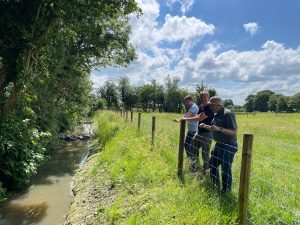
L to R: NFGWS development officer James McElearney with Ross Mac Donald and James McGlone from Stranooden GWS visiting their excellent source protection work.
Stranooden GWS is Investing Upstream to Protect Drinking Water
A recent visit by NFGWS staff to Stranooden Group Water Scheme in County Monaghan provided an opportunity to see first-hand how source protection is moving from theory to practice. Serving more than 1,200 domestic and 500 non-domestic connections across rural Monaghan, Stranooden GWS has become one of the leading examples of proactive catchment management in Ireland. Notably, it is the first group water scheme in the country to employ a dedicated full-time source protection officer, Ross Mac Donald.
Like many schemes that rely on surface water sources, Stranooden faces ongoing challenges from nutrients, pesticides, sediment and other pollutants entering its source water. The scheme abstracts water from White Lough, locally known as Baird's Shore, a shallow lake with a large catchment encompassing five sub-catchments and numerous streams which ultimately influence raw water quality.
However, the lesson from Stranooden is clear: protecting drinking water starts long before water reaches the treatment plant.
For many years, water quality discussions have focused on treatment infrastructure. While treatment remains essential, Stranooden GWS has demonstrated that investing in source protection can deliver significant benefits by reducing pollution before it reaches the abstraction point. The scheme believes that every euro invested in improving raw water quality can generate substantial savings at the treatment stage, while also improving environmental outcomes.
According to Ross Mac Donald, the philosophy is simple:
Research estimates that for every £1 invested in our source catchments there will be £3.36 worth of benefits through reduced water treatment costs and improved catchment ecosystem services.
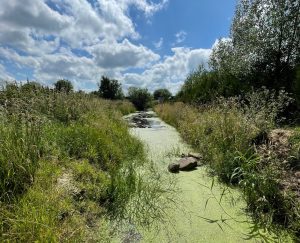
The use of boulders to alter the flow of streams is one of the important source protection measures applied by Stranooden GWS.
Effective Targeted Approach
What makes the GWS's approach particularly effective is its targeted use of data. Rather than undertaking measures across the entire catchment on a broad basis, the scheme has invested significant effort in monitoring and understanding where pollutants are originating and how they are travelling through the land. Sampling and catchment investigations identified that a relatively small number of locations were responsible for a disproportionate share of the nutrient load reaching the source water. In one example, a single stream was found to be contributing approximately 60% of the phosphorus load within one vulnerable sub-catchment. This evidence-based approach allows resources to be directed where they can have the greatest impact.
As Ross explained during the visit:
The GWS cannot dictate what a farmer does on a day-to-day basis, so you have to look at the pathway.
Instead of focusing solely on rivers and lakes, the scheme examines the routes pollutants take across farmland, through drains, streams and low-lying areas before eventually reaching the water source. By interrupting these pathways, the scheme can significantly reduce nutrient and sediment transport.
A range of practical measures is now being implemented throughout the catchment. Existing landscape features such as disused flax holes are being converted into holding ponds and vegetated treatment areas. One particularly impressive example viewed during the visit was a three-chamber pond system designed to slow water movement, capture sediment and retain nutrients before water continues downstream. Wetland vegetation and native tree species, including willow, birch and Scots pine, are being incorporated to enhance both water quality and biodiversity.
The scheme has also undertaken farmyard improvements where run-off posed a significant risk to nearby watercourses. Strategic fencing, improved livestock control and surface improvements have reduced the potential for sediment, nutrients and organic matter to enter streams. These measures are typically completed within a matter of days but can deliver long-term benefits for both farmers and water quality.
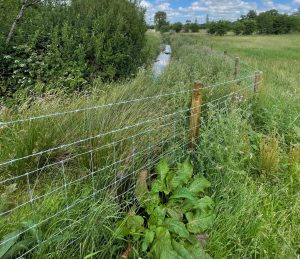
Strategic high quality fencing has improved livestock control and also given measures time to be effective.
Community Collaboration
Perhaps most importantly, Stranooden's success has been built on collaboration with landowners. Every project is agreed with the farmer in advance, with the scheme completing the assessment, mapping, planning and construction. Through its involvement in the Farming for Water EIP, the GWS has taken this a step further by also maintaining and reviewing completed measures over time. This reduces the administrative burden on farmers while ensuring that interventions continue to perform effectively.
The approach demonstrates one of the greatest strengths of group water schemes: local knowledge. By understanding land ownership, farming practices, terrain and catchment characteristics, schemes are uniquely positioned to identify practical solutions that work for both water quality and local communities.
The results are encouraging. Stranooden GWS first became heavily involved in source protection following concerns regarding pesticides in its source water and participation in the NFGWS Source Protection Pilot Project in 2019, which was funded by the Department of Housing, Local Government and Heritage. Since then, extensive work has been carried out across the catchment, including approximately 22 kilometres of targeted fencing and a range of nature-based solutions. Encouragingly, the scheme reports that White Lough was identified as one of the few lakes showing a downward trend in phosphorus levels. Further analysis is needed to verify this trend in the long-term but it shows promise that their focused catchment interventions could be making a real difference.
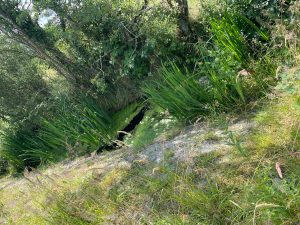
Converting old flax holes is an effective part of the nature-based solutions. They are now used as holding ponds and vegetative treatment areas. Improving the raw water quality entering the GWS treatment plant.
Invest in Understanding
For other group water schemes, the message is not that they need a full-time source protection officer or extensive resources to begin. Rather, the key lessons are to understand your source, gather evidence, identify priority areas and engage positively with local landowners. The most effective source protection measures are often those implemented in the right place rather than the largest or most visible projects.
As the pressures on water quality continue to increase, source protection will become an increasingly important part of safeguarding rural drinking water supplies. Stranooden GWS has shown that through local leadership, partnership with farmers and targeted investment, Group water schemes can play a vital role in protecting both their drinking water sources and the wider environment.
If you would like to find out more about the source protection work, please visit Stranooden GWS online at: www.stranoodengws.ie
This website uses cookies to improve your experience. This website uses cookies We use cookies to analyse our traffic. We also share information about your use of our site with analytics partners who may combine it with other information that you’ve provided to them or that they’ve collected from your use of their services. You consent to our cookies if you continue to use our website.AcceptRejectRead MoreSettings
Privacy & Cookies Policy
Privacy Overview
This website uses cookies to improve your experience while you navigate through the website. Out of these, the cookies that are categorized as necessary are stored on your browser as they are essential for the working of basic functionalities of the website. We also use third-party cookies that help us analyze and understand how you use this website. These cookies will be stored in your browser only with your consent. You also have the option to opt-out of these cookies. But opting out of some of these cookies may affect your browsing experience.
Necessary cookies are absolutely essential for the website to function properly. This category only includes cookies that ensures basic functionalities and security features of the website. These cookies do not store any personal information.
Functional cookies help to perform certain functionalities like sharing the content of the website on social media platforms, collect feedbacks, and other third-party features.
Performance cookies are used to understand and analyze the key performance indexes of the website which helps in delivering a better user experience for the visitors.
Analytical cookies are used to understand how visitors interact with the website. These cookies help provide information on metrics the number of visitors, bounce rate, traffic source, etc.
Cookie
Duration
Description
_ga
2 years
The _ga cookie, installed by Google Analytics, calculates visitor, session and campaign data and also keeps track of site usage for the site's analytics report. The cookie stores information anonymously and assigns a randomly generated number to recognize unique visitors.
_gat_gtag_UA_134711029_1
1 minute
Set by Google to distinguish users.
_gid
1 day
Installed by Google Analytics, _gid cookie stores information on how visitors use a website, while also creating an analytics report of the website's performance. Some of the data that are collected include the number of visitors, their source, and the pages they visit anonymously.
CONSENT
2 years
YouTube sets this cookie via embedded youtube-videos and registers anonymous statistical data.
Advertisement cookies are used to provide visitors with relevant ads and marketing campaigns. These cookies track visitors across websites and collect information to provide customized ads.
Cookie
Duration
Description
VISITOR_INFO1_LIVE
5 months 27 days
A cookie set by YouTube to measure bandwidth that determines whether the user gets the new or old player interface.
YSC
session
YSC cookie is set by Youtube and is used to track the views of embedded videos on Youtube pages.
yt-remote-connected-devices
never
YouTube sets this cookie to store the video preferences of the user using embedded YouTube video.
yt-remote-device-id
never
YouTube sets this cookie to store the video preferences of the user using embedded YouTube video.